In the seminal text The Second Sex, Simone De Beauvoir puts forward the three themes that justified the need for feminism at her time: immanence, women conflated with their reproductive organs, and the structural discrimination against women by virtue of how girls are raised as opposed to boys. This discrimination, De Beauvoir argued, ensured that girls were brought up to believe that male domination is conditioned, ‘his power learned’, where women is conditioned to deny her true self in order to achieve happiness in society.
The Russian punk collective Pussy Riot translate into action these themes with their three themes: feminism, protest, punk.
Feminism
Pussy Riot wear their balaclavas and masks to draw attention away from their gender, their feminine form, and force their audiences to view them as an idea rather than women. The promiment philosopher and cultural critic Slavoj Zizek elaborated on this:
[blockquote align=center]
“Their message is: ideas matter. They are conceptual artists in the noblest sense of the word: artists who embody an Idea. This is why they wear balaclavas: masks of deindividualization, of liberating anonymity. The message of their balaclavas is that it doesn’t matter which of them are arrested — they’re not individuals, they’re an Idea. And this is why they are such a threat: it is easy to imprison individuals, but try to imprison an Idea!”
[/blockquote]
The collective deconstructs their identities and the outward forms of their bodies to avoid the traps of gender. The collective (before the recent and public spat between Nadya and Masha, and the rest of the collective) espoused strict anonymity and engaged with the public using only pseudonyms, like Squirrel, Blondie, Sparrow, and Seraphim. The collective also are ferocious opponents of the cult of celebrity and have committed to depersonalizing its members in order to not draw attention to any one personality in the collective.
Their faceless indictment of their Russian society has been met with very visible attacks on them. The following is a record of known attacks on them:
the danger posed by pussyriot
http://punkmusic.about.com/b/2012/08/08/pussy-riot-update-prosecutors-call-for-three-year-sentence-for-russian-punks-declare-that-feminism-is-a-mortal-sin.htm
Protest
anti-structure, fluid membership:
Participants Pussy Riot group did not disclose their real names and to communicate with the media used an alias that is, in his own words, often changed between them. The press mentioned activist group Balaklava, Manko, Tyurya, Garaja (Garadzha Matveyeva), Blondie, Chowder, Hat, Schumacher, Seraphim, reins, Cat, Washer, Sparrow (Sparrow) and Belka (Squirrel). Pussy Riot have always been in hiding his face knitted masks and repeatedly stressed that the team member “anonymous and interchangeable.”
source: http://lenta.ru/lib/14216713/
their full socio-political agenda:
Participants art project formulate its socio-political agenda as follows: feminism, the struggle with law enforcement, the protection of LGBT -soobschestva, antiputinizm , radical decentralization of power in Russia, the salvation of the Khimki forest and transfer of the capital of Russia in eastern Siberia.
source: russian wikipedia page
Show detailed map of all known Pussy Riot performances using StoryMapJS
This article appeared first on SABC News Online and has been reprinted here with permission. The interview below has been edited.
The Ask Afrika Orange Index released last month reveals noteworthy trends about top-performing companies in South Africa and sheds light on the customer behaviours that drive that performance. A press release issued last month stated,”[The index] is the broadest and most widely-referenced service excellence benchmark in South Africa, comparing service levels across 32 industries and ranking 155 companies in 2014.”
Ask Afrika MD Sarina De Beer
In an interview with Ask Afrika MD Sarina de Beer, she explained that there is a greater call for social capital and responsibility to be pushed into the private sector.
DiSA: Where does Ask Afrika position itself in the marketplace?
AA: We are the largest locally-owned research company. We’re still 100% local shareholding, which is fairly unique compared to the big players in market research. But we still believe that it actually creates the opportunity for us to really understand the local market and not just work with global or international models that we would try to enforce on the local context.
De Beer goes on to comment on data collected about companies’ role in combating unemployment.
AA: [We have seen] the phenomenon of social capital of companies in uplifting unemployment, as consumers are migrating the public sector responsibility to private sector. So what the particular services or obligations that [consumers] find that the public sector is not adhering to or not meeting sufficiently, they are migrating that responsibility back into private sector.
So these things are actually where [consumers] believe what private sector should be contributing towards, [that is] what are the public service dimensions that the private sector needs to make a difference or contribute towards, and this is actually the performance difference. So, for instance, if they rated private sector on ‘promote honesty and transparency’ last year to this year, they actually think that private sector is actually performing worse. On average, it’s actually 9% drop.
What we’re seeing at the moment is that public sector responsibility is migrating into private sector and private sector responsibility is almost migrated back into the consumer, so the consumer needs to pick up the red tape, the inconvenience, [things like] FICA, legislation and regulations in place, this has now become my responsibility as the consumer. I need to make sure that I don’t share my details, I need to make sure that I complete all these forms to make sure that there is no fraud that can be committed on my account etc. So it’s almost pushing the responsibility back to the consumer.
DiSA: What are companies doing to combat or offset this push back to the consumer?
AA: If you look at all the innovation that’s happening at the moment from the marketing perspective and from a product perspective, we are not seeing the same innovation in the service space or environment. We’re asking companies, why can’t you be more innovative in the service space? Why can’t we be better at finding innovative solutions to make sure we don’t transfer the responsibility back to the consumer? Why can’t we use the innovative capability and actually take the responsibility back to corporate where it actually should sit?
DiSA: In your opinion, why is there so little innovation in the service space?
AA: Personally, marketing and brand is where the investment goes. I think it’s the bit that’s almost ‘sexier’ to a certain extent; it’s where I can also get something back from the consumer. So to a very large extent if my product or marketing tactics are very, very innovative, I get more from the consumer, I can get them and manipulate them to spend more money.
[Companies] do so much on loyalty cards and understanding the consumers better and really getting into their mindspace, but we normally do that to actually understand to get more from them, to sell more to them, to get them to spend more money with us, but we don’t use that same kind of innovation to do something that’s purely just beneficial to the customer.
So I think that normally it is to the benefit of the brand. Another practical example is the Postal Services strike. Very, very quickly, companies became very, very innovative and very quick to actually communicate to customers now about their statements, what they owe on particular accounts, before the Postal Strike, you just had to go and collect your statement from the mail and you knew it was your responsibility to figure out what you need to pay.
But the moment that didn’t work, all of a sudden there was a far more SMS communication, e-mailing of statements, very proactively done, not necessarily on request of customer, but it’s again to collect the money, it’s again to benefit the brand. But I don’t think we don’t balance it, I don’t think from the service perspective we give back to the customer.
DiSA: Do you think this is a challenge in the South African market only or is this something you have seen, recorded, or noted in other markets in Africa or worldwide, that companies are operating from their brand only, and not thinking about the customer?
AA: I think probably you’d find the elements of that globally, but I do think that it is a little bit more severe in South Africa. I do think that we are more focused on drawing the boundaries, making sure we operate within our own boundaries, making sure that the rest is the customer’s responsibility, and also the thing is to a large extent the South African consumers are not yet as vocal as you may find in Europe and America, so we still tolerate a little bit more than what we should. I think we would prefer sometimes rather to complain on social media sites, we don’t necessarily always stand on our ground within the corporate structure.
DiSA: Do you think companies take complaints on social media and sites like Hellopeter seriously?
AA: Yes, they do. Unfortunately, they take complaints more seriously than a direct complaint – often a faster turnaround. The minute something is on social media, companies think, “I am careful of the reputation, so I want to deal with this fairly quickly.” If something is on Hellopeter, “I want to get rid of it fairly quickly”. It’s sadly symptomatic of why [consumers] escalate to social media. A few years ago, you would have phoned the contact centre, got upset, asked for the supervisor, asked for the manager, but you would have escalated it inside of the company. We now are more likely to go very quickly outside of the company. It’s a matter of a lack of social capital in the company, we don’t think the company will deal with it fast enough or effectively, so we go to Hellopeter or to social media.
DiSA: Is there any indication of why companies don’t take direct complaints more seriously? Is it a cultural problem?
AA: It is a structural problem, it’s the way service environments are structured. There is so much red tape in terms of what a service agent can and can not do, and how they need to operate. In my opinion, it’s not even working that well on social media, as social media has been traditionally seen as a marketing tool rather than a method of engagement with customers. So, companies have struggled to draw up effective ways and strategies of dealing with queries and complaints sent through social media. The data shows that customers who went through social media gave lower satisfaction scores than those who went through the traditional service channels with their queries.
We measured companies’ success on social media with three different scenarios: are the companies on the relevant platforms? do they engage with customers? if customers do post a query or complaint on social media, how long does it take to successfully resolve the matter? We haven’t seen data that shows a company that does exceptionally well in all three categories. FNB are fairly consistent and that’s why they ended up winning, but there is still room for improvement in all three categories.
De Beer goes on to comment on data collected about companies’ role in combating service delivery and poverty.
AA: There is a decline in perception that private sector is doing less in alleviating poverty than a year ago. These are very strong focus from the consumer perspective, they want to know what companies are doing to make South Africa a better place.
And I think too often that companies are focused on being humble and not necessarily talking about what they are doing. There is often mismatch between what companies do to really contribute and make a difference, and speaking about it. The consumers end up not knowing about what’s done.
Consumers of today are saying, I can choose who I can do business with and I want to do business with a company that actually makes a difference and contributes. Companies leave it up to the customer to build up their own understanding over what companies do in this space. I think that it contributes to the decline of the perception that there is not much happening. Consumers are expecting more.
Reproduced with permission from Ask Afrika
If you look at the companies that normally perform very well on the Orange Index, I do think that the majority of them do quite a lot. Whether it’s efficient or not, as with most things, the more you do, the higher expectations they become.
The consumer becomes used to something and they expect more, the next. Where companies do much for communities, that would be in a separate department than the service guys who are in daily contact with the customer. So although much could be done for the communities, customers may not be feeling that they are valued by companies.
Reproduced with permission from Ask Afrika
DiSA: Could you comment on corporate South Africa’s performance, compared to the rest of Africa?
AA: South Africa performs very well and it’s a pattern we’ve observed over many years. It is also commonly thought that South Africa’s performance would be inferior compared to global standards. There are many industries where we actually perform better than global standards.
For example, we usually do very well in the banking sector. We have looked at international benchmarks previously and we have included them in the Orange Index, but more than half of the industries measured in the index show better performance than what we’re seeing internationally. One also needs to take into account the main drivers behind service excellence in South Africa. This is different than the rest of the world. Things like corporate social responsibility is very pronounced in South Africa and we will not find that trend running across different countries.
We also looked at normative behaviour. [Ed. standard of correctness that follows the rules of society] 50+ age group is the harshest critics of service delivery, they gave the lowest ratings possible. We tend to think that Generation Y would be the most difficult group, but this is not the case according to the data. The 50+ group is also forgotten or is understood in marketing by companies, advertising and marketing seldom focus on that age group in their activities.
Looking across the entire population, the Indian community were far more critical in their ratings than the rest. (ed. AA clarified later that the data for the Indian community, as part of the sample size, was representative of the total population.) Gauteng, Western Cape, and Limpopo proved the most critical provinces, with Western Cape perhaps topping that selection. Limpopo is a bit of surprise, but we need to watch it as there is a lot of development happening in Limpopo.
Reproduced with permission from Ask Afrika
DiSA: What does the data say specifically about Limpopo?
AA: We’ve been seeing over the past 2 years that customers there have been complaining,”Why do I have to pay the same [as Gauteng] when I don’t get the same product range?” … “It’s not as if I’m getting a discount.” … “I don’t get the same service standard, I have to wait longer.” If you look at service in general, in most interactions we’re actually paying for service, not just charges, but you can’t choose your service package. You pay for it, but you don’t have a choice in it. Those discrepancies are going to become problematic. Males and females showed the same behaviours in the data.
DiSA: Some would argue that the innovation should ideally sit within government given the high level of taxation. Why isn’t that happening then, is government not meeting the demand?
AA: It’s not about not meeting the demand, it’s rather being driven by the consumer. The consumer is literally saying that they expect the private sector to do all that [meet those expectations and carry out that innovation]. If I was to ask an open-ended question in the Orange Index, “what would you make you feel valued as a customer?”, the customer would respond, “build a school in my community.”
So the consumers are pushing the responsibility back to private sector, as they are not recognizing sufficient social capital within government. They are however seeing that potential and the social capital in the private sector. [Companies are then] turning that social capital into a service experience.
If we do the statistical modelling on the data, corporate social responsibility is becoming a core driver of customer loyalty. It’s not really customer service [anymore], customers are looking at CSR and making that a part of service.
DiSA: Is this a particularly South African phenomenon?
AA: Yes, it is. You might find it in other countries in a similar fashion, but I think that it is fairly unique to our context. The way we measure service in South Africa is different than how we do it in other countries [in Africa]. We have different issues, we have different things that are important to citizens and we need to understand from a service perspective that our customers are citizens. And I think that actually the shift that we are seeing is that they expect companies to do more. They are expecting companies to do more where ‘it matters’. This is now a very important part of customer loyalty, in particular.
DiSA: This is obviously good for the private sector as it expands their reach and footprint.
AA: Yes, it gives them an opportunity to build affinity towards the brand. A very good, practical example of this is the Outsurance pointsmen, where the company actually are doing something extra. If I was to get two quotes from two short-term insurers and the quotes are very similar, the shift would be towards [Outsurance] as they’re seen to be doing more. They impact lives a bit more than just the premium paid every month. We’ve been picking this up for the past two years and we’re not seeing any signs of decline or change.
DiSA: Given the trust capital, so to say, that companies are now developing with their customers, are companies now on the right track to solve service problems and address consumers’ apathy about traditionally poor areas of delivery?
AA: It’s hard to answer that but I can say that in my direct experiences with clients, there is a massive commitment to addressing problems. However, I don’t think companies are yet good enough at communicating effectively with their consumers. Some companies though are making a massive contribution, but it is not always visible enough. Consumers aren’t always as aware of everything that companies are doing.
Ask Afrika is based in New Muckleneuk in Pretoria.
This article appeared first on SABC News Online and has been reprinted here with permission.
South Africa was named, along with 55 other countries, in Open Society’s “Globalizing Torture” 2013 report, as having cooperated with the United States and the CIA in the rendition (undocumented transport) of terrorism detainees and suspects. The report covers the last 13 years since the 9/11 attack in New York City.
Although not explicitly named in the US Senate report released earlier this week, the Open Society report fills in the gaps left behind when the US Senate report was declassified; many names, countries, and locations were redacted by the Senate Commission.
The Open Society report has a chapter dedicated to South Africa.
The report concludes the chapter,”There are no other known judicial cases or investigations relating to South Africa’s participation in CIA secret detention and extraordinary rendition operations.”
The US Senate Intelligence Committee released its report (4 years in the making) on Tuesday about the CIA torture programme, to the horror and aghast of the global intelligence community and world governments. The report has received wide coverage and criticism since its publishing.
Download both the Open Society (PDF, 1MB, 200+ pages) and Senate (PDF, 14MB, 500+ pages) reports.
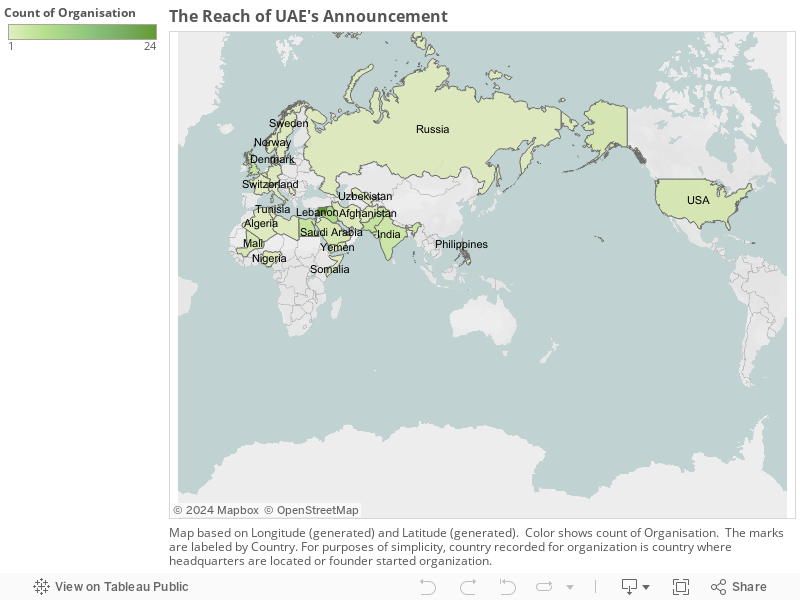
In a bold and sweeping move yesterday, the United Arab Emirates published online through its Emirates News Agency a list of 85 organisations and movements worldwide, now labelled as ‘terrorist’ groups.
Some are expected – like Islamic State and al-Qaeda – but some choices have stunned Europe.
This article appeared first on SABC News Online and has been reprinted here with permission.
Statistics South Africa’s Quarterly Employment Statistics report released on Monday 29 September 2014 shows an overall growth of 1.8%, or 155 000 new jobs created, during the second quarter of 2014. This growth was recorded in the formal non-agricultural sectors of the South African economy. Job losses were documented in the traditional industries: manufacturing, transport, mining, and electricity.
Stats SA Quarterly Employment Figures – Sept 2014
Average monthly earnings and gross earnings increased between February 2014 and May 2014, and March 2014 and June 2014, respectively. The report showed that an estimated monthly average of R15 169 was paid to employees in the formal non-agricultural sector during May 2014.
This entails a 3% quarterly increase between February and May this year, and an overall annual 4.6% increase between May 2013 and May 2014.
Other key points include:
Mining tops the table for gross earnings with R24 million and community services trails at the bottom with a meager R132 373.
Manufacturing showed the highest year-on-year change of 6.1%, while electricity the lowest with 4.5%.
The highest quarterly positive change was in the transport sector with 5.3% and the lowest in finance with a 5.4% negative change.
The entire report is available (PDF, 1.2MB) on the Statistics South Africa’s website.
I apologise for my long silence. The few days’ illness turned into 2 weeks spent in bed. I’m re-establishing my rhythm.
This article summarizes my thoughts about reporting for countries and societies that have no interest in the truth, but rather confirmation for their own biases and opinions:
Covering wars for a polarized nation has destroyed the civic mission I once found in journalism. Why risk it all to get the facts for people who increasingly seem only to seek out the information they want and brand the stories and facts that don’t conform to their opinions as biased or inaccurate?
And without a higher purpose, what is a career as a reporter? It may count among the so-called “glamor jobs” sought after by recent graduates, but one careers website has listed newspaper reporting as the second worst job in America, based on factors such as stress, pay, and employment uncertainty; toiling as a janitor, dishwasher, or garbage collector all scored better. Even if you love the work, it’s hard not to get worn down by a job that sometimes requires you to risk life and limb for readers who wonder if maybe you suffer all the downsides and hazards just to support some hidden agenda.
Every day when I write or argue or think about Egypt, I wonder what is the point when even the most prominent activists are deflated and considering giving up. I’m coming to politics and journalism much later in life than most reporters;yet, I feel a lot of their same disillusionment, frustration, and futility.
I no longer call or consider myself a ‘revolutionary’ because I was never in the streets like others and I never fought on any of the frontlines: media, courts, social activism, so on. This feeling that I am not at all worthy to be called an activist came from reading Alaa’s open letter published yesterday.
El-Watan News reported this morning that Egyptian security services uncovered and detained 13 jihadists involved in planning to set up a local chapter affiliated to the Islamic State (IS).
The most striking part of the article is the following:
وقال أبوصهيب الليبى، القيادى بـ«داعش»، فى فيديو مصور بثته مواقع جهادية، أمس الأول، بعنوان «رسائل من أرض الملاحم»، … ، إن أول من سيبدأ بقتله تنظيم الدولة الإسلامية، حال دخوله مصر، هو الرئيس المعزول محمد مرسى، الطاغوت والمجرم الأكبر، لأنه كان يتمسح بالدين ويتستر به، مضيفاً: «العوام والغلابة كانوا يقولون إنه أكثر حافظ للقرآن، ويقيم الصلاة، لكنه مجرم، وقريباً نتقرب إلى الله بقتل المرتدين والطواغيت فى مصر».
My own translation:
Suhaib el-Libi said 2 days ago in a recorded broadcast, entitled “Messages from the Epic Lands” on a jihadist website … that [upon his entry into Egypt] the first one to be killed is the ousted president Mohamed Morsy because he flirted with the use of religion and used it as protection. He added that common people and the poor would say of him that he knew the Quraan well and attended to his prayers but he is a criminal. Soon we will near ourselves to God by killing the [Muslim] apostates and oppressors in Egypt.
El-Libi won’t be able to achieve this because he died in a military operation in Syria after the broadcast of the video. Clip about Egypt below:
For most commentators and viewers, this is a strange and confusing message. Middle Eastern and Western governments have developed their rhetoric by lumping together all Islamists under one term “terrorism”. But, here is a militant Islamist hoping for the blood on his hands of another Islamist. With this report and yesterday’s piece by Omar Ashour on Al-Jazeera English, a different picture emerges. Key sections of Ashour’s essay below:
In the 1990s, during a low-level insurgency led by the Egyptian Islamic Group (EIG) and the Egyptian al-Jihad Organisation (EJO), the MB offered “assistance” to the Mubarak regime to combat these groups. These political positions aroused the ire of a younger, radical generation of Islamist activists, represented by Ayman al-Zawahiri’s 1993 book, The Bitter Harvest of the Muslim Brothers, in which he criticised the MB’s pragmatic behaviour and gradualist ideology in general and the post-1970 changes in particular.
…
When the “de-radicalisation” process of the EIG ensued in 1997 with their unilateral ceasefire declaration, the MB supported the transition. In 2002, the leadership of the EIG renounced its radical literature, and declared that it replaced its curricula with those of the MB, to signal an acceptance of non-violent gradualist reformism. Overall, from the 1970s onwards, the MB presented itself as a transnational movement that upholds the “correct” form of Islamist sociopolitical activism, which is anti-jihadi and anti-takfiri. From the 1980s, the MB was perceived as an alternative and a rival to Saudi-style Wahabbi form of Islamism.
It seems more likely that the ties between different Islamist groups are more fluid, morphing with the times, circumstances, and political conditions of their respective countries. An example of this is that IS was a part of Al-Qaeda until February this year.
Going back to Egypt, understanding the dynamics and shifting ties between different groups becomes very critical. It may help to understand who burnt the Coptic churches last year in southern Egypt after the violent dispersals of the sitins at Rab’aa and Nahda squares.
Haifa Wahby, Bassem Samra, and the young actor Karim el-Abnoudi
Egyptian Prime Minister banned the controversial film The Beauty of Roh, directed by Sameh Abd-el Aziz, in April 2014 after deeming certain scenes in the film ‘culturally inappropriate sexualized scenes’, as reported by Egypt Independent. The banning was welcomed by swathes of Egyptian society as a much-needed blow to the decadent immorality portrayed in the film and others produced by the megaproduction house of El-Sobky.
Public outcry centered on the rape scene of Haifa Wahby’s character Roh by Mohamed Lotfy’s ‘Jaguar’ (nickname for the character in the film). It would be very dishonest to call the action of the scene rape and it would be very generous to call this a controversial film.
The scene is drenched in the well-lit, overacted, unrealistic melodrama of the main glut of mainstream Egyptian films. This is sad given that a few of el-Sobky’s past films (Ahmed Abdallah’s The Wedding and Cabaret) bucked the trend and chose to eschew realism. However, The Beauty of Roh gives into the temptation and builds as its centerpiece a strange scene, which looks more like non-consenual heavy petty and clothes-ripping. The neurotic and overpowering musical score screams “This is horrid! This is horrid” more than the sheer brutality of a man assaulting and raping a woman. I understand that as someone living outside Egypt and one used to the blunt reality of Western films, this film still is jarring to the average Egyptian viewer. Still, I found it very hard to suspend belief while watching this scene.
I wonder if people in Egypt don’t understand what rape is all about or if directors are so wearied by censorship that their storytelling muscles have atrophied. It becomes easier to just suggest the fuck out of something rather than depict it frankly with cinematic tools.
After watching the film, I was reminded of El-Karnak (The Karnak) – another infamous and controversial film with a rape scene. I had not seen the film but decided to find the scene for the purposes of this review.
I can see where The Beauty of Roh gets its inspiration. Watch.
It’s awkward to watch because it looks or feels nothing like sexual assault. If you’re not going to watch The Beauty of Roh, I’ll save you the money for the cinema ticket or data used and tell you that it’s almost the same. No penetration or sexual abuse. Just physical violence, exposed cleavage, screaming, crying, and a lot of writhing on the floor.
Discounting the supposed horror of the rape scene, the rest of The Beauty of Roh is a poorly constructed and boring film. It’s not clear, not even at the end of the film, if it’s about the relationship between Sayed and Roh or about Roh and her life without her husband or the questionable sources of income of Bassem Samra’s character or a clumsy take on sexual politics and women’s bodies in Egypt.
Bassem Samra is the only redeeming aspect of the film with his visceral and deft characterization. It’s a confused and glossy film with little content, a lot of Wahby’s body, and a dream sequence/music video with Hakeem. The film can’t even manage sending a message out about people to stand up against sexual assault without resorting to a Brechtian “IT’S ABOUT TO GET MORAL UP IN HERE” moment.
You won’t lose much by skipping this film. For a more honest and well-made film about sexual assault, watch 6,7,8, starring Bushra, Bassem Samra, and Nilly Kareem.
Human Rights Watch (HRW) released its extensive report Tuesday 12 August, after a year-long investigation, on the Rab’aa Square killings last year August. Executive director Kenneth Roth and Middle East director Sarah Lead Whitson were detained yesterday at Cairo International Airport before being denied entry into the country. They were due to present the report at a press report entitled All According to Plan.
Roth commented on the authorities’ decision to deny him and his colleague entry:
“We came to Egypt to release a serious report on a serious subject that deserves serious attention from the Egyptian government… instead of denying the messenger entry to Egypt, the Egyptian authorities should seriously consider our conclusions and recommendations and respond with constructive action.”
1) Who were the armed protestors at Rab’aa and Nahda, regardless of their number? Were they armed out of self-defense or were they provided arms by groups or entities?
2) Were the protestors at the sit-in really notified of the dispersal in a timely fashion?